Tuesday, May 7, 2013

My Mother - Carolyn Nelson Blaylock - March 30, 1929 - February 22, 2013

Carolyn's name will be added to Dad's grave stone at last.
video
This was the end of a wonderful week celebrating and laying to rest my mother, Carolyn Nelson Blaylock.

The call came on a Friday evening, February 22, 2013, that she had suffered a stroke and was unresponsive.  She passed a way several hours later with three of my brothers and a few other family members at her side. 

The bonfire was symbolic of many things, but most of all it was a memorable final evening together, sitting around the old picnic tables and visiting, only this time the old picnic tables provided the fire.
What follows are some of the many pictures of my mother as a tribute to her.  This will be my first Mother's Day without a mother.

The weekend of my wedding, January 1974, with my grandmother, Emma Lovisa Nelson, my mother Carolyn, my sister "Buffy", and my mother's sister Emma Dayley.


Picture taken in 2009 at her childhood home in Brigham City, Utah.

We celebrated her 80th birthday with a big family party in Logan, Utah.  This is a picture of all the family that gathered at the Blue Bird Cafe.

Add caption

Add caption


June 2012, Amelia Jean Preece, daughter of Jenny Clinton Preece, meets Great-Grandma for the first (and only) time.

Visiting Grandpa's grave, June 2012

June 1952


Buffy spent Fourth of July 2006 with Mom and got these pictures.

That's me, posing for a picture for my dad who was in Japan as a Marine during the Korean Conflict, July 1953.

Like the caption says, with her granddaughter Sharise on her wedding day. 

Meeting great-grandson Chase Clinton for the first (and last) time, on his 1st birthday,  before he and his Mom & Dad, Chris and Lindsay, move to Japan.  November 2012.

One of the first pictures taken at the family farm purchased by Paul and Edna Blaylock in 1950.  This shot was on Christmas Day 1953.

Dean and Carolyn Blaylock, 1952


Some more shots from her 80th birthday celebration, 2009.

Carolyn and her sister Emma.

The birdhouse on Carolyn's front yard garden.

A family reunion in 2000 included a wonderful water slide that even Carolyn couldn't resist.

Carolyn and her posterity at her 80th birthday party, 2009.


Thursday, April 25, 2013

More B&Bs

Just catching up on my basket and blanket repertoire.

Baskets
Back track last summer.  This market basket is probably my favorite.  I like the shape, I like how it turned out, even with one rather weak reed that didn't weave like the others.  I just like this basket, and as soon as I have more handles I'll make more.
Farmers Market Basket

And now for some epic failures.  The Sandy Neck beach basket.  I was excited to make this because it was going to be soft and light.  The pattern says it should be about 15 inches in diameter.
Sandy Neck Beach Basket
As you can see it ended up about three feet in diameter.  I want a redo.  I've made lemonade out of this lemon, as you can see.  It is perfect for corralling my odds-and-ends of reed.  It is indeed soft and pliable and gets thrown around a lot.  

Next fail - I needed six last-minute "something I love" Christmas gift exchange somethings.  I thought I'd be able to put together some baskets out of materials in my stash (isn't that what quilters call their shelves of unassigned fabrics).  This was the result:
Prototype Basket
The picture is actually very kind to this "kid."  It's off centered, lopsided, and scrappy.  It also has been given a job in my work room.  I am proud of the center bottom.  It turned out perfect.
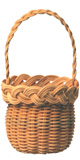
ChristmasOrnament2011.jpg


This is what I ended up doing for the Christmas gift exchange.  They turned out nice, little basket Christmas tree ornaments.


About a year ago I got to go with Bob to LasVegas for a month.  We enjoyed exploring the area around Lake Mead.  At one museum I bout a couple of basket kits in the Native American woven grass style.  The basket is made from paper rolls and raffia, simulating the dried grass.  I have a new appreciation for early American weavers.
This represents three days of work.  My fingers were raw and hands cramped.  I haven't worked on it in months, waiting to find some flexible thimbles, which I have now found.  Just can't bring myself to pick it up again.

I just returned from two months with the kids in the U.S. I arrived just before Valentines Day and left just after Easter.  Here are the two symbols of the seasons.
Mini-Heart Basket
Easter Basket
I got to see all but one of the grands around Easter time and made one for each.


When Jenny was pregnant she asked me to make some baskets for the shelves in the Amelia's room.  These were my first self-designed baskets.  There were six in all, and I love how they look on Amelia's shelves.
Nursery Shelf Baskets

I got to share making baskets with Sarah and Alison around Thanksgiving time.  It was so much fun to see them proud of the finished product.

Alison

Sarah

This is another of my favorites.  When Bob gave me a bicycle last year on my birthday, it just wasn't complete without a basket.
Bicycle Basket

~~~~~~~~~~

Blankets
I've turned a corner from more knitting to crochet.  After my first attempt with Chase's blanket I got bold.  While at Tracee's July 2011 I admired a knitted blanket she'd received as a gift and felt sure that I could duplicate it.  This was the result:
IT'S HUGE!!  See, I neglected to get an accurate stitch count off of Tracee's blanket so I totally guessed.  It is about the size of the top of a queen-sized bed and took like what seemed forever to finish.  But it is one of my favorites, one I actually use.  It's like wrapping up in a favorite sweater.  This is the redo, soft and baby-sized, and took no time at all to finish.

When you find a good thing, why deviate from it?  I used the gingham-checked pattern I used with my first knitting attempt for Chase to make a larger blanket for Kelly.
Gingham Checked Knit

This next one I thought was a stretch but the pattern turned out to be lots easier than I thought it would be.  This is the picture off the website - I gave the original away before photographing it.  I'm in the process of making another only all white.

Rainbow Entralac Baby Blanket

This is the last crochet project I did.  It was a very frustrating pattern, in fact I left it alone while I did two other projects.  It seemed like every square turned out differently no matter how I counted and measured.  I finally finished it, though, for what it's worth.
Lacy Valentine


Monday, December 24, 2012

In Shepherds' Fields

I was one of the narrators at our branch Christmas service yesterday.  Part of my script included a touching story.  The branch music director who wrote the program and assembled all the music and performers told me to just mention the source, which at the time was only noted as Ensign 2008.  I did a little investigating and discovered that it was written by our branch music director herself.  She rolled her eyes at me like a teenager when I went against her orders and gave the name of the author, and was proud to do so.  The story and the program were perfect for our little flock.  Just wanted to share her story.

In Shepherds’ Field


By Annie Tintle,  Ensign December 2008

While attending Brigham Young University, I studied in Jerusalem with approximately 170 students during the fall of 1998. As the Christmas season approached, we began to focus our studies and field trips around the birth of the Savior.


Luke 2:8-20
"The Announcement 
of Christ's Birth to the 
Shepherds" 
by Del Parsons


It was cool and windy the evening that 40 of us pulled up to our last and most anticipated stop for the day. Tradition held that Shepherds’ Field, located just outside of Bethlehem, was the place where the ancient shepherds sat watching sheep on the night of the Savior’s birth, never anticipating what would soon be proclaimed to them.

The field was nothing like I had imagined. I saw a terraced hill with hardly any greenery. We walked down a rocky path, and each of us found a quiet place to sit and write in our journals. I finally found a large rock to sit on. It was cold, uncomfortable, and surrounded by thorns.

When we were told we would be able to see the local shepherds and their sheep, I wasn’t prepared to see children in rags. But even though they were dressed in worn, secondhand clothing, their eyes were bright. Open-palmed, they approached our group’s chaperone. After asking the children their names, she gave each one a few shekels. One of the children carried a newborn lamb. He approached me and offered to let me hold it.

Luke 2:8-14
"The Angel Appears
to the Shepherds,
'Good Tidings of Great Joy'"
by Walter Rane
I took the warm baby lamb in my arms, I began to see the situation differently.

The Savior knew about the life of a shepherd. He knew about the cold nights, rocky trails, and danger of thieves and predators. He knew shepherds sometimes held the baby lambs in their arms, standing watch while waiting for the darkness to pass.

While the Wise Men were able to bring the Christ
child gifts of gold, frankincense, and myrrh, the shepherds could offer little in the way of material gifts. Their sacrifice was simply in coming to offer humble hearts and joyful spirits in partaking in the celebration of their infant Lord.

The Savior has brought the gift of joy to our cold and dreary world. He has promised to stand watch through the long, dark night, despite the terrors and hardships this life can bring. He knows us, His sheep. He is our Shepherd.

That night I began to understand the promise in the gift of our Savior.

Tuesday, November 20, 2012

Thanksgiving History


Most stories of Thanksgiving history start with the harvest celebration of the pilgrims and the Native Americans that took place in the autumn of 1621. Although they did have a three-day feast in celebration of a good harvest, and the local natives did participate, this "first thanksgiving" was not a holiday, simply a gathering. There is little evidence that this feast of thanks led directly to our modern Thanksgiving Day holiday. Thanksgiving can, however, be traced back to 1863 when Pres. Lincoln became the first president to proclaim Thanksgiving Day. The holiday has been a fixture of late November ever since. However, since most school children are taught that the first Thanksgiving was held in 1621 with the Pilgrims and Indians, let us take a closer look at just what took place leading up to that event, and then what happened in the centuries afterward that finally gave us our modern Thanksgiving.

The Pilgrims who sailed to this country aboard the Mayflower were originally members of the English Separatist Church (a Puritan sect). They had earlier fled their home in England and sailed to Holland (The Netherlands) to escape religious persecution. There, they enjoyed more religious tolerance, but they eventually became disenchanted with the Dutch way of life, thinking it ungodly. Seeking a better life, the Separatists negotiated with a London stock company to finance a pilgrimage to America. Most of those making the trip aboard the Mayflower were non-Separatists, but were hired to protect the company's interests. Only about one-third of the original colonists were Separatists.
The Pilgrims set ground at Plymouth Rock on December 11, 1620. Their first winter was devastating. At the beginning of the following fall, they had lost 46 of the original 102 who sailed on the Mayflower. But the harvest of 1621 was a bountiful one. And the remaining colonists decided to celebrate with a feast - including 91 natives who had helped the Pilgrims survive their first year. It is believed that the Pilgrims would not have made it through the year without the help of the natives. The feast was more of a traditional English harvest festival than a true "thanksgiving" observance. It lasted three days.

Governor William Bradford sent "four men fowling" after wild ducks and geese. It is not certain that wild turkey was part of their feast. However, it is certain that they had venison. The term "turkey" was used by the Pilgrims to mean any sort of wild fowl.http://wilstar.com/images/fall-basket.gif
Another modern staple at almost every Thanksgiving table is pumpkin pie. But it is unlikely that the first feast included that treat. The supply of flour had been long diminished, so there was no bread or pastries of any kind. However, they did eat boiled pumpkin, and they produced a type of fried bread from their corn crop. There was also no milk, cider, potatoes, or butter. There was no domestic cattle for dairy products, and the newly-discovered potato was still considered by many Europeans to be poisonous. But the feast did include fish, berries, watercress, lobster, dried fruit, clams, venison, and plums.

This "thanksgiving" feast was not repeated the following year. Many years passed before the event was repeated. It wasn't until June of 1676 that another Day of thanksgiving was proclaimed. On June 20 of that year the governing council of Charlestown, Massachusetts, held a meeting to determine how best to express thanks for the good fortune that had seen their community securely established. By unanimous vote they instructed Edward Rawson, the clerk, to proclaim June 29 as a day of thanksgiving. It is notable that this thanksgiving celebration probably did not include Native Americans, as the celebration was meant partly to be in recognition of the colonists' recent victory over the "heathen natives," (see the proclamation). By then, it had become apparent to the settlers that the natives were a hindrance to their quest for more land, so the good will they shared at the first feast had long been lost. A hundred years later, in October of 1777 all 13 colonies joined in a thanksgiving celebration. It also commemorated the patriotic victory over the British at Saratoga. But it was a one-time affair.

http://wilstar.com/images/turkey-girl.jpg
George Washington proclaimed a National Day of Thanksgiving in 1789, although some were opposed to it. There was discord among the colonies, many feeling the hardships of a few pilgrims did not warrant a national holiday. And later, President Thomas Jefferson opposed the idea of having a day of thanksgiving.

It was Sarah Josepha Hale, a magazine editor, whose efforts eventually led to what we recognize as Thanksgiving. Hale wrote many editorials championing her cause in her Boston Ladies' Magazine, and later, in Godey's Lady's Book. Finally, after a 40-year campaign of writing editorials and letters to governors and presidents, Hale's obsession became a reality when, in 1863, President Lincoln proclaimed the last Thursday in November as a national day of Thanksgiving.

http://wilstar.com/images/hornofplenty.jpgThanksgiving was proclaimed by every president after Lincoln. The date was changed a couple of times, most recently by Franklin Roosevelt, who set it up one week to the next-to-last Thursday in order to create a longer Christmas shopping season. Public uproar against this decision caused the president to move Thanksgiving back to its original date two years later. And in 1941, Thanksgiving was finally sanctioned by Congress as a legal holiday, as the fourth Thursday in November.