Tuesday, November 20, 2012

Thanksgiving History


Most stories of Thanksgiving history start with the harvest celebration of the pilgrims and the Native Americans that took place in the autumn of 1621. Although they did have a three-day feast in celebration of a good harvest, and the local natives did participate, this "first thanksgiving" was not a holiday, simply a gathering. There is little evidence that this feast of thanks led directly to our modern Thanksgiving Day holiday. Thanksgiving can, however, be traced back to 1863 when Pres. Lincoln became the first president to proclaim Thanksgiving Day. The holiday has been a fixture of late November ever since. However, since most school children are taught that the first Thanksgiving was held in 1621 with the Pilgrims and Indians, let us take a closer look at just what took place leading up to that event, and then what happened in the centuries afterward that finally gave us our modern Thanksgiving.

The Pilgrims who sailed to this country aboard the Mayflower were originally members of the English Separatist Church (a Puritan sect). They had earlier fled their home in England and sailed to Holland (The Netherlands) to escape religious persecution. There, they enjoyed more religious tolerance, but they eventually became disenchanted with the Dutch way of life, thinking it ungodly. Seeking a better life, the Separatists negotiated with a London stock company to finance a pilgrimage to America. Most of those making the trip aboard the Mayflower were non-Separatists, but were hired to protect the company's interests. Only about one-third of the original colonists were Separatists.
The Pilgrims set ground at Plymouth Rock on December 11, 1620. Their first winter was devastating. At the beginning of the following fall, they had lost 46 of the original 102 who sailed on the Mayflower. But the harvest of 1621 was a bountiful one. And the remaining colonists decided to celebrate with a feast - including 91 natives who had helped the Pilgrims survive their first year. It is believed that the Pilgrims would not have made it through the year without the help of the natives. The feast was more of a traditional English harvest festival than a true "thanksgiving" observance. It lasted three days.

Governor William Bradford sent "four men fowling" after wild ducks and geese. It is not certain that wild turkey was part of their feast. However, it is certain that they had venison. The term "turkey" was used by the Pilgrims to mean any sort of wild fowl.http://wilstar.com/images/fall-basket.gif
Another modern staple at almost every Thanksgiving table is pumpkin pie. But it is unlikely that the first feast included that treat. The supply of flour had been long diminished, so there was no bread or pastries of any kind. However, they did eat boiled pumpkin, and they produced a type of fried bread from their corn crop. There was also no milk, cider, potatoes, or butter. There was no domestic cattle for dairy products, and the newly-discovered potato was still considered by many Europeans to be poisonous. But the feast did include fish, berries, watercress, lobster, dried fruit, clams, venison, and plums.

This "thanksgiving" feast was not repeated the following year. Many years passed before the event was repeated. It wasn't until June of 1676 that another Day of thanksgiving was proclaimed. On June 20 of that year the governing council of Charlestown, Massachusetts, held a meeting to determine how best to express thanks for the good fortune that had seen their community securely established. By unanimous vote they instructed Edward Rawson, the clerk, to proclaim June 29 as a day of thanksgiving. It is notable that this thanksgiving celebration probably did not include Native Americans, as the celebration was meant partly to be in recognition of the colonists' recent victory over the "heathen natives," (see the proclamation). By then, it had become apparent to the settlers that the natives were a hindrance to their quest for more land, so the good will they shared at the first feast had long been lost. A hundred years later, in October of 1777 all 13 colonies joined in a thanksgiving celebration. It also commemorated the patriotic victory over the British at Saratoga. But it was a one-time affair.

http://wilstar.com/images/turkey-girl.jpg
George Washington proclaimed a National Day of Thanksgiving in 1789, although some were opposed to it. There was discord among the colonies, many feeling the hardships of a few pilgrims did not warrant a national holiday. And later, President Thomas Jefferson opposed the idea of having a day of thanksgiving.

It was Sarah Josepha Hale, a magazine editor, whose efforts eventually led to what we recognize as Thanksgiving. Hale wrote many editorials championing her cause in her Boston Ladies' Magazine, and later, in Godey's Lady's Book. Finally, after a 40-year campaign of writing editorials and letters to governors and presidents, Hale's obsession became a reality when, in 1863, President Lincoln proclaimed the last Thursday in November as a national day of Thanksgiving.

http://wilstar.com/images/hornofplenty.jpgThanksgiving was proclaimed by every president after Lincoln. The date was changed a couple of times, most recently by Franklin Roosevelt, who set it up one week to the next-to-last Thursday in order to create a longer Christmas shopping season. Public uproar against this decision caused the president to move Thanksgiving back to its original date two years later. And in 1941, Thanksgiving was finally sanctioned by Congress as a legal holiday, as the fourth Thursday in November.

Saturday, January 21, 2012

The Five Days of Our Anniversary

On the first day of our anniversary, my DH gave to me flowers and a lovely, sentimental card.

On the second day of our anniversary, my DH gave to me a creamer for my collection, and a lovely, sentimental card.

On the third day of our anniversary, my DH gave to me more flowers for my collection and a lovely, sentimental card.

Isn't he just the best?

B&Bs


Just so's you don't think I've been too awfully idle lately, here are my latest projects.

Baskets
 Laundry Basket - This was actually easier than I thought it was going to be.  Harder on the hands, but a pretty easy weave once it got going.  The inside is rather rough, which is where the rough part of the construction is supposed to be.  With time I'm sure even my rough stuff won't be so harsh.  Meanwhile, since this is a laundry basket, I think I'll have to line it so it doesn't snag the clothes.  Either that or relegate it to the garden.


Weed Basket - These were some of my first little projects.  They've just been hanging around my house so long I forgot to include them in the photographs.  They hold my... er... weeds.  You know, the parts of your flower arrangements that never die?


Potato Basket - This basket uses the same technique as an egg or melon basket only on a larger scale.  

Peach Basket - This one is actually a re-do.  I wasn't happy with the dye job on the first one (see below), or the weaving, or the shape, or the finish.....  so much wrong with the first one.  The blue looks better, my weaving is more even, but I still see lots of room for improvement.

And then there are the blankets.  


In July we got our very first grandgirl, Casey.  This pink and hearts was for her.  It looks good with the Cabbage Patch Kids in the antique baby bed, but now is at home in Casey's nursery, which is purple.  It works.


In November we got our fourth grandboy.  this time I tried knitting and for a first attempt it turned out pretty good.


Wednesday, November 30, 2011

Grand News

My son, Chris, his wife Lindsay, and the newest grand boy, 
Chase Robert Clinton.
Born 11.30.2011, 1:48 PM, Corpus Christi, Texas
6 lb. 3 oz, 19 inches

Chris says he's caught bigger fish than Chase.

Thursday, November 24, 2011

"....give thanks in all circumstances..."

Originally posted in November 2008, and it still one of my favorites.  
Read and give thanks.  
Happy Thanksgiving.

~^~^~^~^~^~^~^~^~^~^~^~
Thanksgiving is the perfect time of year to follow the admonition of the popular hymn and "Count Your Many Blessings." Here is a great story of thankfulness:

Corrie Ten Boom and her sister Betsie were Dutch women and devout Christians who hid Jews in their home during World War II, until the sisters were captured by the Gestapo and imprisoned. When they were transferred to Ravensbruck, the women's concentration camp, and moved into new quarters, their barracks were crawling with fleas. Corrie and Betsie had always been scrupulously clean and these vermin were abhorrent to them. Corrie tells the story:

"Here! And here's another one!" I wailed, "Betsie, how can we live in such a place!" "Show us. Show us how." It was said so matter of factly it took me a second to realize she was praying. More and more the distinction between prayer and the rest of life seemed to be vanishing for Betsie.

"Corrie!" she said excitedly. "He's given us the answer! Before we asked, as He always does! In the Bible this morning. Where was it? Read that part again!" I glanced down the long dim aisle to make sure no guard was in sight, then drew the Bible from its pouch. ... "Here it is: 'Comfort the frightened, help the weak, be patient with everyone. See that none of you repays evil for evil, but always seek to do good to one another and to all... . Rejoice always, pray constantly, give thanks in all circumstances; for this is the will of God in Christ Jesus--(1 Thessalonians 5:14-18)..... .'"

"That's it, Corrie! That's his answer. 'Give thanks in all circumstances!' That's what we can do. We can start right now to thank God for every single thing about this new barracks!" I stared at her, then around me at the dark, foul-aired room.

"Such as?" I said.

"Such as being assigned here together."

I bit my lip. "Oh yes, Lord Jesus!"

"Such as what you're holding in your hands." I looked down at the Bible. "Yes! Thank you, dear Lord, that there was no inspection when we entered here! Thank you for all the women, here in this room, who will meet you in these pages."

"Yes," said Betsie, "Thank you for the very crowding here. Since we're packed so close, that many more will hear!"

She looked at me expectantly. "Corrie!" she prodded. "Oh, all right. Thank you for the jammed, crammed, stuffed, packed, suffocating crowds."

"Thank you," Betsie went on serenely, "for the fleas and for --" The fleas! This was too much. "Betsie, there's no way even God can make me grateful for a flea."

"'Give thanks in all circumstances,'" she quoted. "It doesn't say, 'in pleasant circumstances.' Fleas are part of this place where God has put us."

And so we stood between piers of bunks and gave thanks for fleas. But this time I was sure Betsie was wrong.

But as events turned out, it was Betsie who was right. Both Corrie and Betsie were diligent missionaries, constantly bearing testimony to God, bringing the hope of Christ to women trapped in that dreadful place. Betsie was too sick to go out with the brigades of women workers into the forest where the women had to gather wood. She was assigned to knit stockings for German soldiers; and because there were so many women, Betsie was in a group that had to work in the barracks instead of the work room. She was a lightning knitter who completed her quota ... long before noon. She kept our Bible with her and spent hours each [afternoon] reading aloud from it, moving from [sleeping] platform to platform.

One evening I got back to the barracks late... . Betsie was waiting for me, as always, so that we could wait through the food line together. Her eyes were twinkling. "You're looking extraordinarily pleased with yourself," I told her.

"You know we've never understood why we had so much freedom in the big room," she said. "Well-I've found out." That afternoon, she said, there'd been confusion in her knitting group about sock sizes and they'd asked the supervisor to come and settle it. "But she wouldn't. She wouldn't step through the door and neither would the guards. And you know why?" Betsie could not keep the triumph from her voice: "Because of the fleas! That's what she said, 'That place is crawling with fleas.'"

My mind rushed back to our first hour in this place. I remembered Betsie's bowed head, remembered her thanks to God for creatures I could see no use for. (Corrie Ten Boom, The Hiding Place, [New York: Bantam Books, 1971].)

Regarding thankfulness, President Monson has noted: "Gracias, danke, merci -- whatever language is spoken, 'thank you' frequently expressed will cheer your spirit, broaden your friendships, and lift your lives to a higher pathway as you journey toward perfection. There is a simplicity -- even a sincerity -- when “thank you” is spoken." (Source: President Thomas S. Monson, Think to Thank, Ensign (CR), November 1998, p. 17.)

Here's a website where you can learn how to write "Thank You" in over 465 different languages: http://www.elite.net/~runner/jennifers/thankyou.htm

Wednesday, October 5, 2011

Underwater Basket Weaving

I like baskets.  They are rustic, functional, light-weight (which is important when you move every four years), and decorative.  Many years ago an acquaintance, who just happened to be an interior decorator, tipped me off to these basketry advantages.

Fast forward a decade or so, in Montgomery, Alabama for the summer while Bob went to a military school.  The wife of one of the instructors at this school invited me over one day to make a basket.  Heck, why not.  It turned out to be enjoyable, and the basket is one of the best I've done.

Fast forward another decade or so, on the island of Okinawa.  Another acquaintance makes baskets and is also giving classes to others interested.  Well, sign me up.    


This is one of the first baskets I made, after the one in Alabama.  It's called a jelly jar basket because theoretically it holds two jars of jelly.  Mine holds travel brochures and maps.  Maybe someday when I'm tired of crochet and baskets and seminary I'll take up scrap booking and and put all the brochures in that instead of a baseket.

This basket maker on Okinawa carried a charming tote with her all the time, a basket.  I wanted to advance to the point where I could make one just like it.  Before I could do that, she explained, my shaping skills had to be pretty good or it could turn out looking like a bottle.  She was right.  The above basket - don't recall if it has a name, was one of my first attempts at controlling shape as I weave.  I'm rather proud of this one.  The picture doesn't really do it justice, and sadly it attracted some mildew and had to be bleached as you can see around the bottom.  It holds some stuffed animals in my living room when the occasional child stops in.


I made this one at a unit spouses function for - guess what? - the Fourth of July.

I think there were some other baskets along the way, but finally my instructor gave me permission to make the tote I wanted.  This picture totally does the basket justice.  I used it for about four years as my purse, my lunch tote, travel carry on, everything.  As you can see there are weavers broken out of it, the rim is in bad need of repair, and the handle is faded.  It has been given emeritis status, until today when I took it down off the top of the schränk in our bedroom for photographing.  I think it's time for some cleaning and repairs.

Fast forward a couple more decades.  I'm still interested in baskets and weaving them, but until just recently hadn't found a good source for materials.  When we lived in the states I just always thought that Hobby Lobby or Michael's would carry them.  Guess what? 

Early in the summer I decided to look on line, see what was out there for basketry and **woo-who** there are lots of resources!  I ordered a kit, it came in under a week, and then I got on a plane, leaving it behind.  I ordered the same kit while I was there thinking my two daughters and I could make the three baskets together.  Silly me - one has three boys and the other had a brand new baby girl.  I enjoyed watching busy little boys fill my tub of soaking reeds with Matchbox cars and garden tools, and Tracee and Kelly got a basket each out of my efforts.

When I got home in August I got my kits out - the same ones I'd ordered in Colorado, and made the above three baskets.  Basket weaving involves a lot of water, and it's not the neatest hobby.  I find the best place to work is outdoors.  I love setting myself up on the patio on a sunny day.  It takes me about four hours to make a basket, so about one a day is my limit. 


Kelly chose not to have a handle on the basket she made, so I carried it home with me and made this basket with it and some other scraps that I brought home from Colorado.


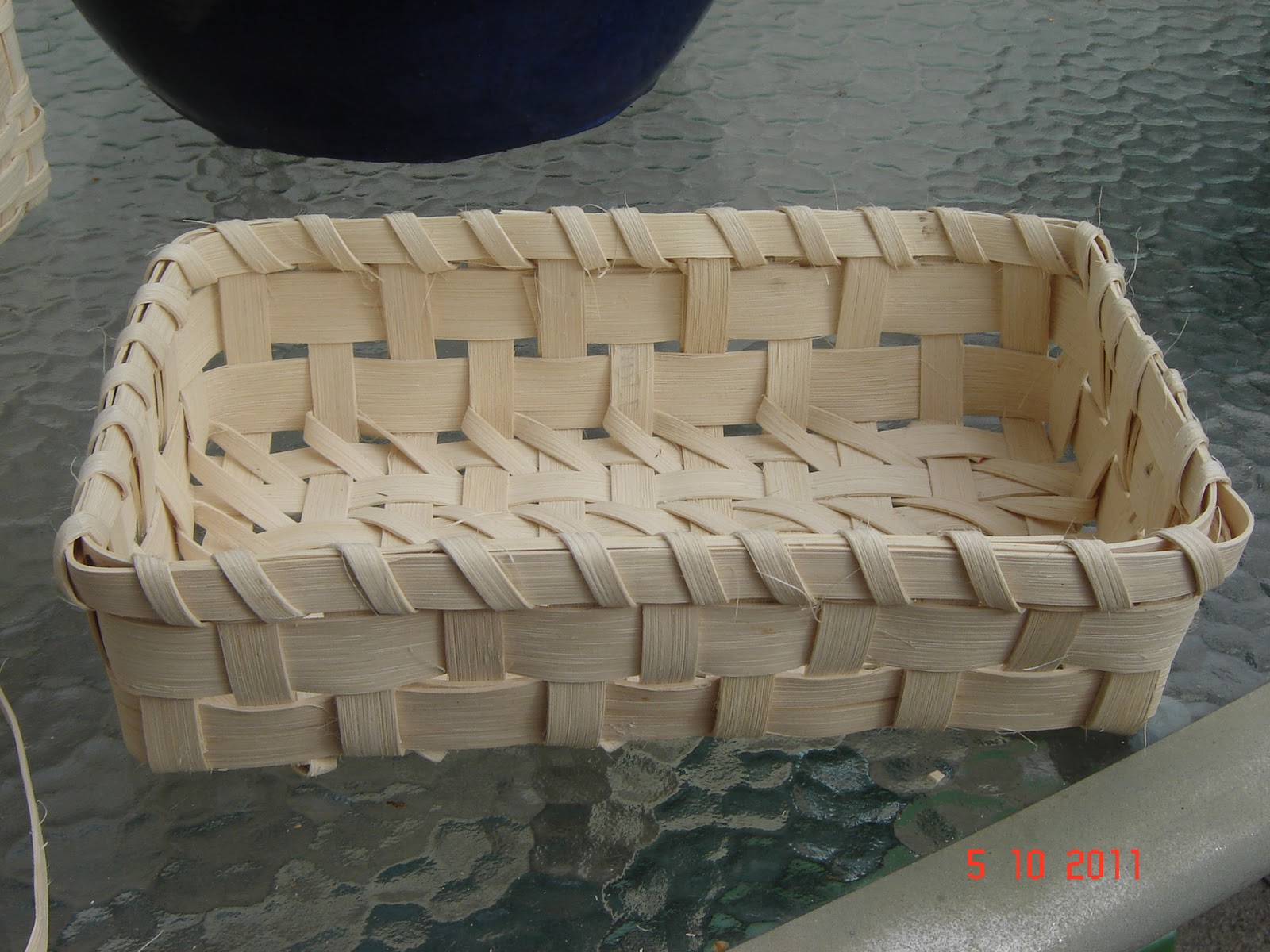
We have had such perfect weather this September and in to October.  My sunny patio was calling me out.  I pulled out what reed I had left and made these two.  It is my first attempt at making my own pattern.  The larger one I made using the measurements of some shelf baskets we bought at IKEA.  I was really worried at first, but I LOVE the way it turned out! Even the caning on the rim, which I don't like to use, turned out well (and I had exactly enough!).


This smaller one will take it's place next to my mousepad and keyboard to hold all the little things I use all the time that tend to end up loose on my desk - glue sticks, White Out, marking crayons, my glasses, an eraser, thumb drives....  It was one of the hardest first rows I've eve done!  The one-inch reed is hard to manipulate for the first row, but it, too, turned out so good.

The one draw back to basketry is that unless you buy kits - and I feel my skill level is beyond kits - is that you have to buy reed in such large quantities that in order to make my next basket I have to purchase about $90 worth of supplies.  The advantage is that shipment will keep me weaving for several months.

I should mention that the very first basket I made, a medium melon basket, dipped in a walnut shell soak, with a wrapped handle, is still one of the best I ever did.  I wanted to include it's picture in this entry and it's not where I thought it was.  I can't imagine where it has gone to, and won't stop hunting till I find it.

Thanks for listening.